


 Follow Us
WFC3 Persistence Project
Persistence in the WFC3/IR Images
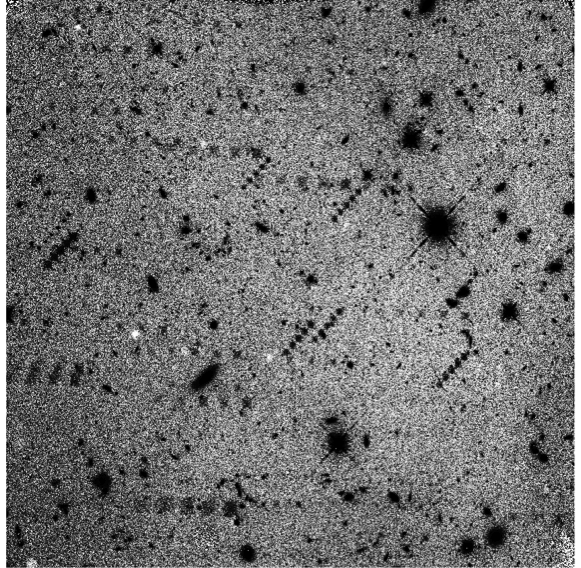
Like essentially al IR arrays, the WFC3/IR detector exhibits
after-images, known as persistence, following exposure to light
that approaches or exceeds the saturation level of individual
pixels of the detector. In extreme cases, this
persistence can be seen for several hours in WFC3. As a result,
persistence can affect science exposures not only within a single
visit, but also in exposures of later visit. A description
of persistence in the WFC3/IR detector can be found on the WFC3 IR persistence page: https://www.stsci.edu/hst/instrumentation/wfc3/data-analysis/ir-persistence.
Normally, persistence due to images within a visit is not a
problem, because most observers use small dithers and the
after-glow images are faint. As a result, afterglows within
a visit are usually undetectable since they are found in the wings
of the point spread function of the follow-on images.
Persistence due to earlier visits, while less common, can be
more of a problem scientifically, since the after-images from
earlier visits can be anywhere in the science images of the
current visit. The numbers of programs which have been
adversely affected are small, but observers need to be aware of
the possibility.
In order to help observers assess the degree to which a their exposures are affected, STScI has developed a model for persistence as it exists in WFC3. The team have used this model and the time-history of earlier exposures to generate estimates of the amount of persistence in each "flt" file and to produce fits files that contain estimates for each pixel in each "flt" file. We also produce a persistence-subtracted "flt" file.
Since persistence due to images within a visit and those from
previous visits reflect different issues, we distinguish between
the two. We call persistence within a visit "internal
persistence", and persistence from earlier visits "external
persistence."
Access to Persistence Information for WFC3/IR
These data are available through the browser at http://archive.stsci.edu/pub/wfc3_persist/, sorted by Program ID and Visits within each Program ID.
When you uncompress the tar.gz file in each Visit folder, you will find files of the following types:
- <rootname>_extper.fits - estimate of the external persistence
- <rootname>_persist.fits - estimate of the total (internal + external) persistence
- <rootname>_flt_cor.fits - persistence subtracted flt file
Observers should be cautioned that the persistence
model is only an approximation to the actual persistence.
Therefore, one should not "blindly" replace the standard 'flt"
files with the persistence-corrected flt files in downstream
analysis. A better strategy in some cases, may be to use the
external persistence file to flag bad pixels for downstream
analysis. In other cases scaling the models up or down by a small
factor may result in a cleaner corrected image.
Observers and archive users are encouraged to contact the help desk (help@stsci.edu) if the persistence subtraction substantially limits their ability to extract science from an image or set of images.
Users who have encounter problems downloading the data should contact
the archive help desk archive@stsci.edu.
 |
|
|
|
|
|
|
|
|
|