


 Follow Us

|

About BEFS
- Instrument Description 1986
- Instrument Description 1990
- ORFEUS 1 Instrument Performance
- ORFEUS 2 Instrument Performance
Berkeley Extreme and Far-UV Spectrometer (BEFS) flew the Orbiting and Retrievable Far and Extreme Ultraviolet Spectrograph (ORFEUS)-SPAS for 5 days in September 1993 and again for 14 days in November 1996.
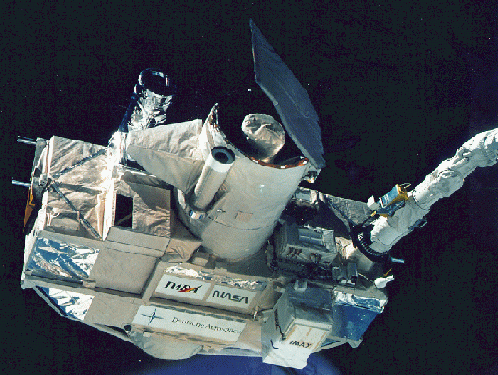
The picture shows the ORFEUS-SPAS during checkout on the shuttle arm
prior to deployment during the first flight. The BEFS is clearly
visible at the prime focus of the telescope. The two electronics boxes
to the right of the telescope (in partial shadow) contain the
supporting electronics. Extending from the telescope tube to the left
is the AIT/LSW Echelle spectrometer. The small telescope in the
foreground is the Astro-SPAS star tracker; the long, shiny tube on the
far side of the platform is Princeton's IMAPS experiment.
The ORFEUS telescope is 1 meter in diameter and 4 meters long . The
Berkeley spectrometer sits at the prime focus of the f/2.4 normal
incidence primary mirror. This instrument is designed to provide
high-resolution ( /5000)
spectroscopy of point sources between 390 and 1200 Å simultaneously,
with an effective area of about 4 - 6 cm2. Alternatively, an
off-axis paraboloidal mirror
can be driven into the light path, collimating the beam and directing
it into an Echelle spectrometer provided by AIT and the
Landessternwarte Heidelberg (LSW). That instrument is designed to
provide /10,000 spectroscopy of
point sources between 900 and 1250 Å
at somewhat lower sensitivity.
/5000)
spectroscopy of point sources between 390 and 1200 Å simultaneously,
with an effective area of about 4 - 6 cm2. Alternatively, an
off-axis paraboloidal mirror
can be driven into the light path, collimating the beam and directing
it into an Echelle spectrometer provided by AIT and the
Landessternwarte Heidelberg (LSW). That instrument is designed to
provide /10,000 spectroscopy of
point sources between 900 and 1250 Å
at somewhat lower sensitivity.
The resolution of the ORFEUS spectrometers significantly exceeds that
of other instruments with comparable sensitivity at wavelengths of
overlap. Below 760 Å, the spectrometers on the Extreme Ultraviolet
Explorer offer somewhat lower sensitivity (but longer observing times),
and a resolution of /300. Between
800 and 1250 Å, the Hopkins Ultraviolet Telescope offers higher
sensitivity, and comparable observing times, but again the resolution
is about /300. The
Hubble Space Telescope is limited to wavelengths longer than about 1170 Å.
FUSE, the Far Ultraviolet Spectroscopic Explorer, can achieve a resolution as
great as /30,000 in this wave band,
but cannot observe objects brighter than 1.0x10⁻¹⁰ ergs cm-2 s-1 Å-1. The ORFEUS and FUSE data sets are thus complimentary.
Information about the instrument was taken from Hurwitz, M., & Bowyer, S., "The Berkeley Spectrometer for ORFEUS: Laboratory and In-Flight Performance" in Astrophysics in the Extreme Ultraviolet, ed. S Bowyer & R. F. Malina (Dordrecht: Kluwer Academic Publishers), 601-609, 1996
 |
|
|
|
|
|
|
|
|
|