

Mission Overview
Parallel Ionizing Emissivity Survey (PIE)
Primary Investigator: Claudia Scarlata
HLSP Authors: Alexander Beckett, Marc Rafelski, Wanjia Hu, Ilias Goovaerts
Released: 2026-08-21
Updated: 2026-08-21
Primary Reference(s): Beckett et al. 2025
DOI: 10.17909/emsa-yj13
Citations: See ADS Statistics
Source Data:
- MAST Portal DOI
- HST GO Proposal: 17147
Overview
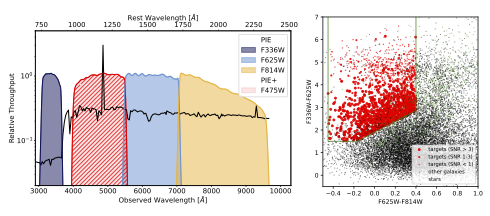
The Parallel Ionizing Emissivity (PIE) survey is a large Pure Parallel HST program (PID 17147, PI Scarlata) designed to constrain the emission of Lyman continuum (LyC) radiation in galaxies at 3.1 < z < 3.5. By observing several independent fields across the sky, PIE will remove the uncertainty due to IGM absorption along the line of sight and measure average LyC escape fractions as a function of galaxy properties. PIE has imaged 37 independent fields in three filters (F336W, F625W and F814W), of which 18 are observed with a fourth band (F475W) from the accompanying PIE+ program (PID 17518, PI Beckett). PIE uses photometric colors to select candidate Lyman Break Galaxies (LBGs) at z ~ 3, which can be followed up spectroscopically to confirm their redshifts.
Producing a large sample of galaxies at z > 3 across many independent fields is vital to calibrate indirect indicators of LyC emission during the Epoch of Reionization, where these LyC photons drove the reionization of the early Universe but cannot be observed due to the opacity of the IGM. The catalog includes over 1400 galaxies selected as likely high-redshift LBGs, of which over 500 are expected to lie at the 3.1 < z < 3.5 redshift range for which LyC emission can be probed using F336W observations. Spectroscopic follow-up is ongoing to confirm galaxy redshifts as well as measure emission-line diagnostics. These diagnostics include several candidates for useful indirect indicators of LyC emission, which might be used to determine to what extent different galaxies contributed to reionizing the Universe.
This collection includes custom reduction of all the imaging of the PIE fields, as well as model point-spread functions for each filter and field, and photometric catalogs of all detected sources and galaxies selected for spectroscopic follow-up. This current release (v1) includes our images and photometric catalogs for the 37 completed fields.
Data Products
The first data release includes the HST data from the 37 fields with at least three bands of imaging from the combination of the original PIE program (GO 17147, PI: Scarlata) and the PIE+ supplementary program (GO 17518, PI: Beckett), as well as model PSFs and photometric catalogs. Future releases will include further imaging from HST (GO 18126, PI: Beckett), as well as spectroscopy of 12 fields with JWST (GO 9365, PI: Scarlata).
Data file naming convention:
hlsp_pie_hst_wfc3_<field>_<filter>_v1_<product_type>.fits
where:
- <field>: Is the the target field designation for images and either "all-sources", "all-galaxies", or "selected-galaxies" for source catalogs
- <filter>: Is the filter designation. F336W, F475W, F625W, F814W for images and "multi" for source catalogs.
- <product_type>: Is "drz", "model-psf" for observations or "phot-cat" for source catalogs.
Data file types:
| _drz.fits | Custom-reduced drizzled images for each field, where all 3 or 4 images are wcs-aligned and pixel-aligned to allow accurate source extraction and photometry |
| _model-psf.fits | Model point-spread function at the correct focus and orientation for each filter and field |
| _phot-cat.fits | Source catalogs including all fields with source locations, photometry, and some morphological information |
Data Access
MAST Portal and Astroquery
The PIE data products are available in the MAST Search Portal (web-based, cross-mission search interface) and Astroquery (Python package to search for and download files from Python scripts you write).
- In the MAST Search Portal, set the Provenance Name filter to "pie" in an Advanced Search to find these data. The user guide for how to search and download products using the MAST Portal is available here.
- For Astroquery, the following example code demonstrates how to search for and download these products. This code assumes that you want to download all products from this HLSP, so you may want to consider narrowing down your search for large HLSPs (> 10 GB) or those with many individual files (> 10k). You can find more astroquery.mast tutorials here.
from astroquery.mast import Observations
# Search for all PIE products
all_obs = Observations.query_criteria(provenance_name="pie")
data_products = Observations.get_product_list(all_obs)
# Print the number of data products that would be downloaded
print(len(data_products))
# Download data
Observations.download_products(data_products)
-
A web-based interface for cross-mission searches of data at MAST or the Virtual Observatory.
-
Search for and download data products for this HLSP programmatically in Python.


Direct Download
The data for this HLSP are available for direct download using the links in the table below:
| Files | Size | Description |
|---|---|---|
| hlsp_pie_hst_wfc3_all-galaxies_multi_v1_phot-cat.fits | 19.1 MB | Photometric catalog for all sources classified as galaxies (Where CLASS_STAR parameter measured using SE is < 0.8). |
| hlsp_pie_hst_wfc3_all-sources_multi_v1_phot-cat.fits | 28.6 MB | Photometric catalog for all detected sources. |
| hlsp_pie_hst_wfc3_selected-galaxies_multi_v1_phot-cat.fits | 780 KB | Photometric catalog for all galaxies with 23.5 < m(F65W) < 26.0 and within the color selection window described in Beckett et al. 2025 |